

Heads up: some links below are affiliate links, which means Quiggly may earn a small commission if you buy through them, at no extra cost to you. We only recommend stuff we'd actually put in our own kids' hands.
Answer first: at six months, a baby needs roughly four objects. Something to grab, something to bang, something to look at, and something to safely put in their mouth (which will be all four of the above). That is not me being cute. Six-month-olds are working on grasping, transferring an object hand to hand, and sitting up without face-planting. There are only so many toys that help with that, and most of the ones marketed to you are not among them.
Here is the whole first year, honestly.
0 to 3 months: they can barely see
Newborn vision is genuinely limited at first. Focal distance is short, and color perception is still coming online over the first few months. What they can pick out is strong contrast, which is why black-and-white patterns hold a newborn's gaze when a pastel giraffe does absolutely nothing.

So the correct toy budget for this window is small. Bold high-contrast cards or soft pieces they can look at during tummy time, and a mirror. That is it. Our High Contrast Newborn Set was built for this exact stretch, and it is intentionally not big, because nobody needs a curriculum for a person who sleeps sixteen hours a day. (More on the why in newborn vision and why contrast matters.)
3 to 6 months: the grabbing era
Somewhere in here the hands come online and everything changes. They reach. They miss. They reach again. Then one day they catch something and immediately try to eat it, and you realize you are now in a completely different job.
What helps: anything light enough for a weak grip, textured enough to be interesting, and safe to mouth. Rattles that do not need a firm shake to make noise. Soft objects with a bit of crinkle. Fabric with different weights and weaves. High contrast is still useful here, and now it is grabbable instead of only lookable.
What does not help: anything that requires them to press a button. They cannot, and being unable to make a toy work is not a fun developmental experience, it is just frustrating.
6 months: the actual answer
This is the age everyone searches for, so let's be specific. A six-month-old is usually sitting with support, transferring objects between hands, and discovering that things exist even when they roll away. Three toys genuinely map to that.
An object permanence box
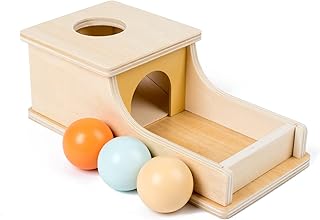
The one classic Montessori material that fully earns the name. A ball goes in a hole, disappears, and rolls out a tray. Gone, then back. For a baby just working out that objects persist, this is riveting, and they will do it forty times in a row. A basic wooden version like this ball drop box is around fifteen dollars and does exactly one thing, which is the point.
Stacking cups

Unglamorous, cheap, and the longest-serving toy I have ever bought. At six months they bang them and mouth them. At one they nest them. At two they use them in the bath, in the sand, as scoops, as hats. The First Years Stack & Count Cups cost less than a coffee and outlast most of the wooden stuff.
Something high contrast they can hold
Vision is still developing well past six months, and bold patterns keep working. The difference now is that they can bring it to their own face, turn it, and gum the corner, which is real sensory work. This is the stretch where our newborn set quietly keeps earning its keep instead of getting boxed up at twelve weeks.
As an Amazon Associate, Quiggly earns from qualifying purchases.
6 to 12 months: it gets loud

Crawling, pulling up, cruising, and an intense new interest in containers. They will empty anything you fill. This is the age where a low basket of a few real objects beats almost any toy, and where a set of open-ended wooden pieces starts to make sense as a purchase you keep for years rather than months. Ours is the Wooden Rainbow Building Blocks set, which at this stage is mostly a thing to bang together and take out of a basket, and that is a completely legitimate use.
What to skip in the first year
Activity centers that do nine things. Anything with a screen. The plush toy with a battery pack that giggles when you tip it. Toy "sets" with fifteen pieces, because a baby cannot use fifteen pieces and you will find eleven of them under the couch in November.
And skip the guilt entirely. A six-month-old playing with a wooden spoon and a colander is not behind. That is a kid doing exactly the right thing with excellent materials.
The honest summary
Buy three or four things for the whole first year. Choose them for what your baby is working on right now, not what a box says they will learn. Put them somewhere the baby can actually reach.
Then spend the rest of your money on those professional family photos you know you should take (trust me, you should).