

Answer first: the best toys for motor skills are usually the simplest ones. Open-ended toys that make little hands grasp, stack, pinch, thread, and balance do far more than any battery-powered toy that does the work for them. If a toy lights up and spins on its own, your kid is watching. If your kid has to make it work, they're building skills.
Quick, no-lab-coat version: fine motor is the small stuff (fingers and hands, the grip that eventually holds a crayon and works a zipper), and gross motor is the big stuff (core, arms, legs, balance, the whole-body coordination behind climbing and jumping). You don't need a different toy for every muscle, the best ones hit several at once. We split the picks below into fine-motor and gross-motor so you can grab what your kid actually needs.
My almost-three-year-old is my in-house tester (her signature move is loading a basket with everything she can find and hauling it across the house). My seven-year-old, meanwhile, is deep in a space phase, which is exactly why one of these is very much for the bigger kids. Here's what actually builds those skills, and what to skip.
Heads up: some links below are affiliate links, which means Quiggly may earn a small commission if you buy through them, at no extra cost to you. We only recommend stuff we'd actually put in our own kids' hands. As an Amazon Associate, Quiggly earns from qualifying purchases.
Fine-motor toys (little hands and fingers)
1. Wooden Rainbow Building Blocks (our pick)

If I kept one toy for motor skills, it would be a good set of blocks, which is exactly why we make ours. Grasping and placing (fine motor), balancing a tall tower without knocking it over (control and patience), and the constant problem-solving of "will this piece stay up?" They grow with the kid too, from a baby banging two together to a five-year-old building an entire city. No batteries, no instructions, no single right answer.
2. High-Contrast Newborn Set (our pick for babies)

At the very start (0 to 4 months), motor skills begin with reaching and batting. Our high-contrast newborn set gives new babies something bold enough to actually see and swipe at, which is how those first arm and hand movements get going. The earliest "toy that builds motor skills" is really just something worth reaching for.
3. Nesting & Stacking Cups

The classic for a reason. Nesting and stacking teaches size order, hand-eye coordination, and the pincer grip, and this set doubles as bath and beach toys. Chunky enough for a baby to grab, interesting enough to keep a two-year-old sorting.
4. Wooden Shape-Sorter Activity Cube

Shape sorting plus a little hammer-and-pound bench means fine-motor placement and early problem-solving in one wooden cube. The turn-and-fit motion is fantastic for little wrists, and the click of a shape dropping into place is pure toddler satisfaction.
5. Tongs & Color-Sorting Set
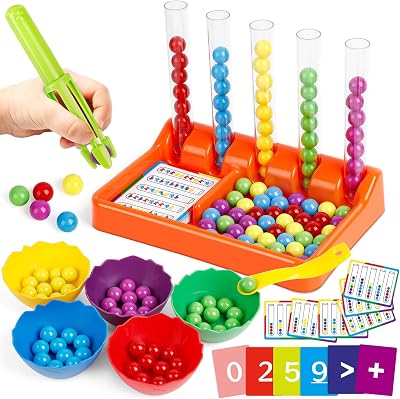
Tongs and tweezers are Montessori gold: pinching balls into cups builds exactly the hand strength behind holding a pencil. This counting-and-sorting kit folds in color and number practice too, and it's the kind of quiet activity that buys you a surprisingly long stretch.
6. Silicone Lacing Toy

Threading a lace through holes is a two-hands-doing-different-jobs workout, and one of the better predictors of the hand control kids need for writing later. This silicone alpaca is soft, chunky, and toddler-friendly (and it travels well in a diaper bag).
7. Magnetic Alphabet Maze

Guiding a magnetic bead through a maze is precise, absorbing fine-motor work, with letters and colors folded right in. Great for the 3-to-5 crowd who like a bit of a challenge and a clear "I did it" at the end.
8. Space Magnetic Tiles (for the bigger kids)

For the bigger kids (and the space-obsessed ones, I have one at home): magnetic tiles are fine-motor plus spatial reasoning plus open-ended building, and this set leans all the way into rockets and astronauts. Magnetic building is one of the rare toys that genuinely holds a seven-year-old and a three-year-old at the same table.
Gross-motor toys (whole body)
9. Kids' Maze Wobble Board

Time to get the whole body in. A wobble board builds core strength, balance, and focus, and this one adds a maze on top, so the challenge becomes "stay balanced AND steer the ball." Perfect for getting the wiggles out on the days when going outside just isn't happening.
10. Balance Beam & Stepping Stones

A little floor obstacle course: balance beam, stepping stones, and a ring-toss and flag game. Builds coordination, balance, and the confidence that comes from crossing the room without touching the lava. Bonus: it stores flat, which matters when it lives in your living room.
11. Pool Ring Toss

Coordination doesn't have to be serious. A pool ring toss turns aim-and-throw practice into a whole afternoon, and it's a great one for the warmer months or a trip. Simple, active, and genuinely fun for the whole family.
What to skip
The toy that does everything for your kid. If it flashes, sings, and spins the moment they tap one button, the toy is doing the work and your child is just an audience. Same for most "educational" tablets at this age. Motor skills are built by hands that have to try, wobble, and try again. Skip the stuff that removes the effort, because the effort is the entire benefit.
The bottom line
You don't need a shelf of specialized gadgets to build motor skills. A few open-ended, hands-on toys, a bit of balance work, and plenty of "let me try it myself" will do more than any light-up wonder-toy. If you start with one, make it the Wooden Rainbow Building Blocks, then add whatever fits your kid's stage from the list above and let those little hands get to work.
As an Amazon Associate, Quiggly earns from qualifying purchases. We only recommend products we'd give our own kids.